


What to expect during your first chiropractic appointment!
- Amber Kenmuir
- Apr 8
- 4 min read
First-time appointments can cause a little nervousness as you don’t know what to expect. You may have seen a chiropractor before but you may still be unsure of what to expect during your first appointment with a new chiropractor. This information sheet is to let you know a little of what will happen so you know what to expect.
History and what brings you in: to start with, your chiropractor will review what has brought you into the office, as well as what has happened in the past that may be contributing to what is going on now. Many people don’t realize that just because everything is feeling okay, doesn't mean everything is where it supposed to be. The body is amazing at adapting and changing according to what is going on outside and inside of you. Pain is the body’s way of telling us there is too much going on for it to handle on it’s own, and that it needs help.
Sensory and motor testing: this is used to see how some of your nerves are functioning. Sometimes when there is a degenerated disc, herniated disc, or spinal changes, certain nerves may be pinched. This can affect how your body feels things or how strong your muscles are.
Posture Assessment: Your posture can tell your chiropractor a lot about what is going on inside. Is one hip or shoulder higher? Is your head tilting off to one side? Is your head forward of your shoulders? Are you slouching? All of these can indicate if there are changes to the positioning of your spine, and can also give insight into why some of your muscles may be tighter than others.
Range of Motion Testing: This is where your chiropractor assesses how well you are moving your neck and your low back. We can compare how you move to what is considered “normal”, as well as check if you are moving the same in both directions (IE: turning your head side to side) or can you move more in one direction compared to the other.
Orthopaedic Testing: These are specific tests that help your chiropractor look for things like joint movement, inflammation, as well as disc and/or nerve issues. They can help us to know if it is safe to adjust you, or if something more involved may be going on requiring you to see your medical doctor.
Muscle Palpation: We will feel your muscles to see if they are balanced from side to side, or if one side is tighter than the other. Muscle imbalances can create instability in the spine, contributing to injuries. These imbalances are monitored to see if they balance over the course of treatment. We may also recommend you see a massage therapist, acupuncturist, and/or physiotherapist to help relax chronic muscle tension and/or to get better muscle balancing so you hold your adjustments better. Sometimes it takes a team to get you back on track to health, and to keep you healthy long-term.
Once your chiropractor has completed their testing, they will go through the results with you, explain what is happening, and what the recommended plan is so you can understand what is going on with your body, and what will be needed to get you back on track. They will review the method they use to adjust the spine so you know what to expect with your adjustments. They will then review a consent form explaining all the possible side effects of treatment, and then if you are ready to go ahead, you will sign the consent form, and you will then receive your first adjustment.
Your First Adjustment: Just like there are different kinds of medical doctors, dentists, and physiotherapists, there are different kinds of chiropractors. The goal of a chiropractic adjustment is to not only realign your spine and get things moving that have become stuck, but to also provide neurological input into your nervous system so your brain has a better idea of what is going on in your body, so it can better provide input to help you function better. Your chiropractor at Playworks Physio uses a combination of tools to provide the adjustments, instead of using manual, by-hand adjustments, as tools are just as effective but more comfortable for many patients.
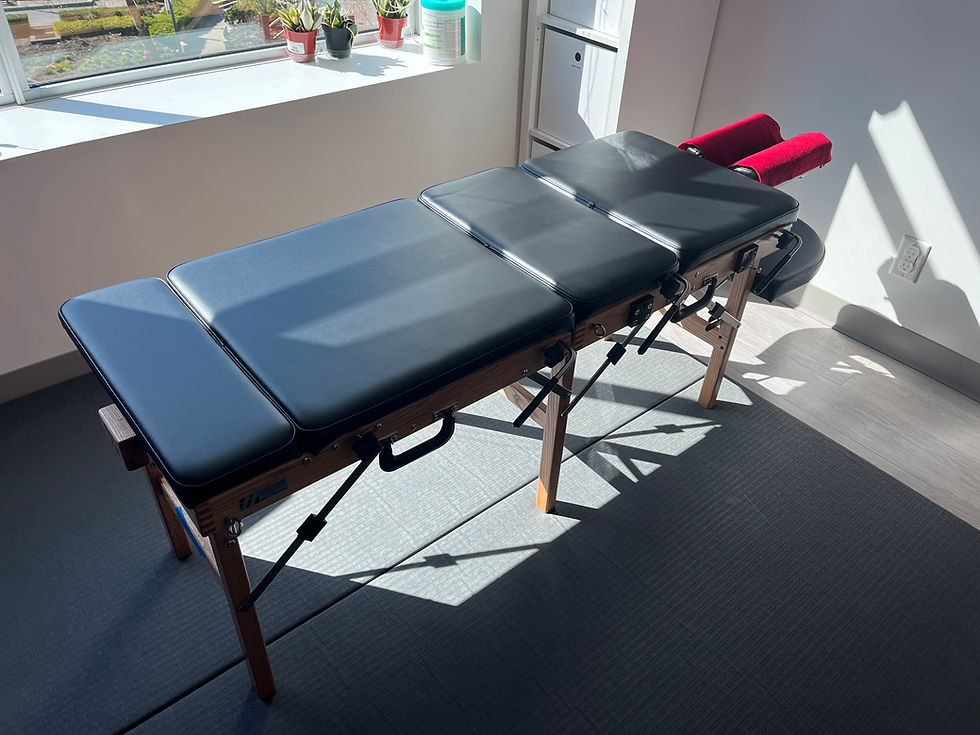
The Drop Table: The drop table is a specific adjusting table that has small pieces that pop up, and then drop down when pushed on. This table is used for adjusting the pelvis. As the chiropractor guides the bones in the direction the bone needs to move, the drop of the table helps the bone move into proper position. It’s a gentle, but effective way of correcting pelvis misalignments.
The Activator: The Activator is a spring-loaded adjusting instrument that is used to move bones back into alignment, as well as provide neurological input into the nervous system. It has 4 different settings, allowing the chiropractor to apply only a specific amount of force to the spine during each adjustment. This means it is adaptable and safe for any age of patient. The tip of the Activator is also quite small, allowing your chiropractor to provide an adjustment to a specific bone, while leaving the neighbouring bones alone. It can also be used to adjust feet, shoulders, knees, etc, making it a very versatile tool.

Hand Adjusting: Rarely, but sometimes your chiropractor will use their hands to provide chiropractic adjustments. These adjustments tend to be more on your shoulder, knee, or feet, and are only used in certain circumstances that the chiropractor deems necessary.
At The End: At the end of your appointment, your chiropractor will give you instructions on how to care for your body, as well as how your body may feel after your adjustment. They may give recommendations for exercise, which can help your body adapt to the changes that will occur. Questions are encouraged but if you don’t have any at that time, that is okay! You can always call or email, or write them down and bring them to your next appointment. Your chiropractor will also let you know when they would like to to return, to help you have the best recovery possible for you.
If you have any questions before your appointment, please contact us. Our chiropractor is more than happy to chat with you on the phone and answer your questions before you come in. We are here for you!


As someone who spends most of the day staring at crypto charts, my neck and upper back used to burn like crazy by midday. Ignoring it only made my trading focus worse. A friend eventually pushed me to see a specialist, so I dropped by https://www.arrowheadclinic.com/chiropractor/georgia/atlanta for a quick assessment. The spinal adjustments completely changed how I feel during long sessions. If desk strain is messing with your day, getting professional alignment here is a huge help.